Why Do I Need the Right Charger Size for a 48V System?

Time:2026-09-22 Author:Amelia
0%

Choosing a charger for a 48V battery system is not simply a matter of matching two numbers. The battery’s chemistry, capacity, charging profile, and intended use all matter. A 48V lithium battery may require approximately 54.6V at full charge, while a 48V lead-acid bank can need a different charging voltage. The difference is easy to overlook. It can affect charging time, battery temperature, and long-term reliability.

So, what size charger do I need for a 48V system? The practical answer begins with battery capacity, measured in amp-hours, or Ah. A 100Ah battery often suits a charger near 10A for a gentle charge, although the manufacturer may permit a higher rate. A technician I worked with once compared charger selection to filling a narrow bottle: pressure matters, not only volume. That comparison is imperfect, but useful.

Isidor Buchmann, founder of Cadex Electronics and Battery University, states, “The charger should match the battery chemistry.” That principle remains important. A lithium battery needs a charger designed for its specific lithium chemistry and battery management system. Lead-acid batteries may require absorption and float stages. Using the wrong profile can leave a battery undercharged, overheated, or permanently weakened.

Cable length and wire size also deserve attention. A charger may be correctly rated but lose performance through thin, warm cables. Check the battery label, charger specifications, and installation manual before connecting anything. Real systems are rarely perfect. Temperature, aging, and daily cycling can change the best choice. A slightly slower charger is often safer than an aggressively oversized one.
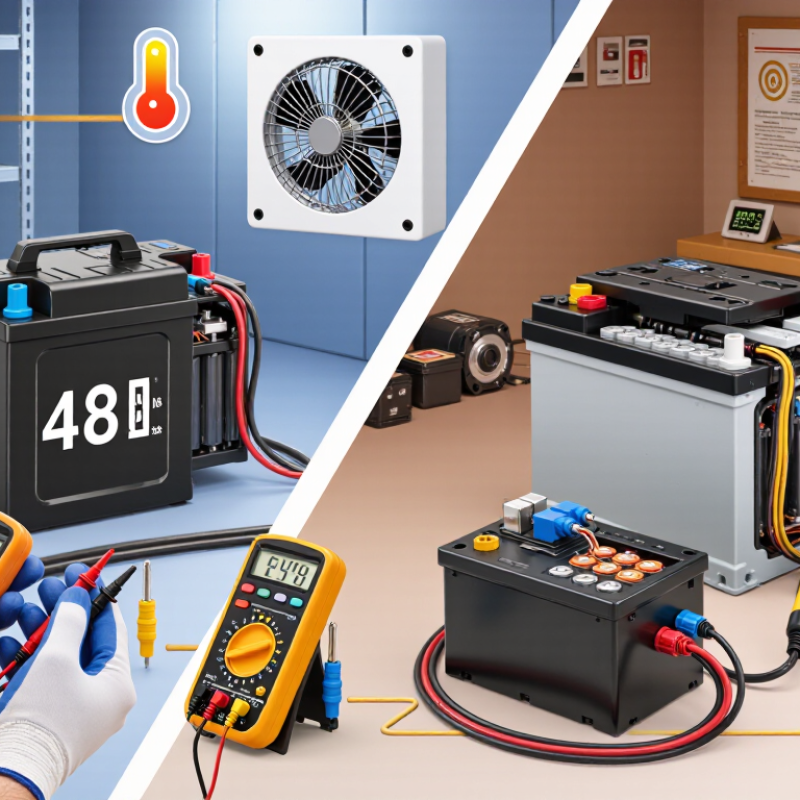
Why Do I Need the Right Charger Size for a 48V System?

What a 48V Charging System Is and How It Works

Why Do I Need the Right Charger Size for a 48V System?

What a 48V Charging System Is and How It Works

A 48V system uses a battery pack with a nominal voltage near 48 volts. The charger does not simply supply 48 volts. It follows a charging profile, usually constant current followed by constant voltage. A 48V lithium iron phosphate pack may require about 58.4V at full charge. A lead-acid pack can require a different voltage and absorption stage. The label “48V” is not precise enough.

Charger size also means output current and power. A 10A charger delivering 58.4V provides roughly 584 watts. Input power will be higher because conversion creates heat. Oversized current can stress cells, cables, or the battery management system. Undersized current may charge safely, but it can extend charging time and leave the system incomplete. The IEA’s Global EV Outlook 2024 reported that electric-vehicle battery demand reached about 750 GWh in 2023. That growth highlights why accurate battery and charger matching matters across modern energy systems. Still, industry reports often discuss large packs, not every small 48V installation.

Tips: Check chemistry, maximum charging voltage, current limit, connector polarity, and BMS requirements. IEC 62619 and applicable electrical safety standards provide useful design references. Measure temperature during charging. A cool cable is reassuring; a warm connector deserves attention. One practical mistake is trusting voltage alone. Current, charging stages, and battery age matter too. Perfect calculations can still miss a damaged cell.

How Voltage and Current Ratings Affect Charger Compatibility

Why Do I Need the Right Charger Size for a 48V System?

A 48V label does not define the charger’s real output voltage. It describes the battery’s nominal voltage. A lithium-ion pack may require about 54.6V, while a 16-cell lithium iron phosphate pack can need approximately 58.4V. Lead-acid batteries may require even different charging stages. The International Energy Agency’s 2024 Global EV Outlook reports that lithium-ion battery prices fell 14% in 2023. This trend supports wider battery use, but it also increases chemistry and charging variation. One charger cannot safely fit every 48V system.

Current ratings matter just as much. For a 100Ah battery, a 20A charger provides a 0.2C charging rate. A 10A unit may take roughly ten hours before charging losses, while a 40A unit can create excess heat or trigger battery-management protection. IEC 60335-2-29 addresses safety requirements for battery chargers, including abnormal operating conditions. Field technicians often check connector polarity, charging profile, and BMS communication before testing voltage. I still find “48V charger” searches too vague. Nominal voltage alone is not enough.

Tips: Match chemistry, charge voltage, current, connector, and BMS requirements. Check the battery label and datasheet, not only the seller’s listing. Allow ventilation around the charger. If the battery becomes unusually warm, stop charging and investigate. A slower charger is inconvenient; an incorrect charger can be dangerous.

Choosing the Correct Charger Size for Battery Capacity

Why Do I Need the Right Charger Size for a 48V System?

Choosing the Correct Charger Size for Battery Capacity

A 48V battery system needs a charger that matches both voltage and battery capacity. A charger with the wrong output voltage may prevent full charging or damage sensitive components. Capacity is usually measured in amp-hours (Ah). For example, a 100Ah battery commonly uses a charger between 10A and 30A, depending on its chemistry and manufacturer limits. This range represents a practical 0.1C to 0.3C charging rate.

Charging time depends on more than capacity. A 100Ah battery charged at 20A may require about five hours under ideal conditions. Real charging often takes longer because efficiency decreases near full capacity. A higher-current charger can reduce waiting time, but it may create extra heat and accelerate battery wear. A smaller charger is gentler, though inconvenient for daily use. The simple rule is not enough. I once focused only on charging speed and overlooked the battery management system’s maximum current.

Tips: Check the battery label and technical manual before choosing a charger. Confirm the charging voltage, chemistry, connector polarity, and maximum current. Leave room for ventilation around the charger. If the battery feels unusually hot, stop charging and investigate the cause. A correctly sized charger should fit your routine, not just the battery’s numbers.

Risks of Using an Undersized or Oversized Charger

Why Do I Need the Right Charger Size for a 48V System?

A 48V battery system needs more than a charger that simply fits the connector. The charger must match the battery chemistry, charging voltage, current, and control profile. In battery service work, I have seen systems appear functional while charging incorrectly. Small mismatches can create serious stress inside the battery. The voltage profile matters most.

An undersized charger usually supplies too little current. Charging then takes much longer, especially after heavy use. If the charger cannot reach the required voltage, the battery may never become fully charged. Lead-acid batteries can develop sulfation after repeated undercharging. Lithium systems may remain below their intended charge level. The charger may also run continuously, increasing heat and reducing its service life. Lower current is usually safer, but only when the voltage and charging profile are correct.

An oversized charger creates a different risk. Excessive current can heat the battery, cables, connectors, and charger. A battery management system may repeatedly disconnect to protect the cells. That interruption is not a healthy charging method. In severe cases, poor wiring or weak connections can become dangerously hot. The charger may also exceed the battery’s approved input limit, even when its label says 48V. I once treated the voltage label as the main specification; that was too simplistic. Current limits, chemistry, ventilation, and cable capacity deserve equal attention. Always verify the battery manufacturer’s charging requirements before connecting a replacement charger.

Why Do I Need the Right Charger Size for a 48V System? - Risks of Using an Undersized or Oversized Charger

Practical comparison of charger voltage, current, charging time, heat, and battery-system risks

Data Dimension Correctly Sized Charger Undersized Charger Oversized Charger Why It Matters
Nominal system voltage 48 V nominal, matched to the battery chemistry May still be labeled 48 V, but delivers insufficient charging voltage or current May exceed the battery’s specified charging voltage “48 V” describes the nominal system voltage, not the exact voltage required during charging.
Typical full-charge voltage Lead-acid systems commonly require about 57.6–59.2 V, depending on battery design and charging profile May stop below the required absorption voltage May exceed the battery manufacturer’s maximum charging voltage The correct voltage limit must come from the battery specifications; lithium and lead-acid batteries use different profiles.
Lithium iron phosphate reference A common 16-cell LiFePO4 pack reaches approximately 58.4 V at 3.65 V per cell Charging may be slow or may not reach full state of charge Excess voltage can trigger the battery-management system or create a safety hazard A charger designed for another chemistry should not be substituted without confirming voltage and charging compatibility.
Battery capacity example 48 V, 100 Ah battery bank; charger selected according to the battery’s approved charge rate Low-current charger, such as 5 A, provides only a small fraction of the bank’s capacity per hour High-current charger, such as 30 A, may exceed the battery’s permitted charge rate Charger current must be compatible with the battery’s rated maximum charge current and the BMS limit.
Approximate charging time For 100 Ah, a 20 A charger may require roughly 5–6 hours from a deeply discharged state, plus the final charging stage A 5 A charger may require more than 20 hours in ideal conditions, with additional time for charging losses and tapering Charging may be faster, but only if the battery, wiring, fuse, BMS, and charger are all rated for the higher current Actual time varies with state of charge, temperature, battery age, efficiency, and the charger’s control algorithm.
Risk of incomplete charging Low when voltage and current settings match the battery requirements High; the battery may regularly remain below a full state of charge Usually low, but incorrect voltage can cause a protection shutdown before charging is complete Repeated undercharging can reduce usable capacity and, in lead-acid batteries, contribute to sulfation.
Heat and energy loss Heat remains within the charger, cable, connector, and battery design limits The charger may operate for longer periods, increasing cumulative operating heat Higher current can increase cable, connector, fuse, and battery heating Electrical cable loss increases approximately with the square of current, so proper wire sizing is essential.
Battery-management-system response Normal operation when voltage, current, and temperature remain within programmed limits May charge slowly without triggering protection, unless the voltage is also incorrect The BMS may disconnect charging because of overvoltage, overcurrent, or excessive temperature A BMS is a protective device, not a substitute for a correctly configured charger.
Cable and fuse requirements Cable cross-section, connectors, and fuse are rated for the charger’s maximum output current Usually creates less current-related stress, but poor connections can still overheat May overload existing cables, connectors, fuses, or circuit protection The complete charging circuit—not only the charger—must be rated for the maximum current.
Recommended selection rule Match chemistry, voltage profile, maximum current, connector polarity, and temperature requirements Do not select solely because the charger is inexpensive or physically compatible Do not assume a higher amp rating means faster or safer charging Always verify the battery datasheet, charger output specifications, BMS limits, and installation wiring before use.
Safety note: The values shown are general engineering references, not universal settings. Use the exact charging voltage, current, temperature range, and charging profile specified for the particular 48 V battery chemistry and configuration.

Steps to Match a Charger with a 48V Battery System

A 48V label does not reveal the correct charging voltage. A lithium-ion system may require 54.6V or 58.4V, depending on its cell arrangement. Lead-acid systems use different absorption settings. Voltage is not enough.

Match the charger in practical steps. Read the battery label and confirm chemistry, cell count, capacity, and maximum charging voltage. Then calculate current from the recommended C-rate. For a 100Ah battery rated at 0.2C, choose about 20A. A 48V × 20A charger delivers roughly 960W before efficiency losses. Battery University’s technical guidance places many lithium-ion batteries near a 0.5C to 1C charging range, but the battery maker’s limit remains more important. I would not treat that range as universal.

Check the battery management system next. It may require temperature protection, communication, or a specific shutdown sequence. Confirm the connector polarity and cable rating, too. A loose terminal can become hot during charging. The International Energy Agency reported about 750GWh of electric-car battery demand in 2023, a 40% rise from 2022. That growth reflects increasingly complex battery systems, not a reason to guess charger size. A rough estimate can mislead. Test at room temperature, monitor voltage, and verify that charging stops correctly. Use a charger designed for the exact chemistry and voltage profile.

FAQS

What does “48V” mean in a battery system?

It describes the battery’s nominal voltage, not its exact charging voltage. A lithium iron phosphate pack may need about 58.4V when full. The label alone is incomplete.

Why must the charger match battery chemistry?

Different chemistries require different voltage limits and charging stages. Lithium-ion systems may use 54.6V or 58.4V. Lead-acid systems need different absorption settings. Using the wrong profile can cause damage.

How do I choose the charger’s current rating?

Check the battery’s recommended C-rate and capacity. A 100Ah battery rated at 0.2C may accept about 20A. This is only an estimate. The battery’s stated limit matters more.

How much power does a 20A charger provide?

At 48V, a 20A charger provides roughly 960 watts before efficiency losses. Actual input power will be higher because conversion produces heat. Expect some loss.

Can a charger with excessive current damage the system?

Yes, excessive current can stress cells, cables, connectors, or the battery management system. Protection circuits may stop charging, but they should not replace correct sizing. Do not rely on luck.

What should I check before connecting a charger?

Confirm chemistry, cell count, maximum charging voltage, current limit, and connector polarity. Check the cable rating as well. A loose terminal may become hot during charging. Warm connectors need attention.

How does the battery management system affect charger selection?

The system may require temperature protection, communication, or a specific shutdown sequence. A compatible charger should support those requirements. A voltage match alone is insufficient.

How can I monitor charging safely?

Charge at room temperature and observe voltage, cables, and connectors. A cool cable is reassuring. Charging should stop correctly at the expected limit. A damaged cell can defeat perfect calculations.

Does a smaller charger always create a safety problem?

Not necessarily. A lower-current charger may charge safely but take much longer. It may also leave the battery incompletely charged. I would not assume slower means completely safe.

Is a larger charger always better?

No. Higher current may shorten charging time but increase heat and electrical stress. Check the battery limit, cable rating, and protection requirements. Convenience can hide a poor match.

Conclusion

A 48V charging system is designed to supply the voltage and current needed to safely restore energy to a 48V battery pack. Voltage must match the battery system, while the charger’s current rating determines how quickly the battery can charge. When asking, “What size charger do I need for a 48V system,” consider both the battery’s capacity, usually measured in amp-hours, and the recommended charging rate. A larger-capacity battery may require a higher-current charger, but the charger must remain within the battery manufacturer’s safe limits.

Using an undersized charger may result in very slow charging, overheating from extended operation, or incomplete charging. An oversized charger can deliver excessive current, increase heat, shorten battery life, or create safety hazards. To choose correctly, confirm the battery’s nominal voltage, chemistry, capacity, connector, charging profile, and maximum permitted current. Then select a compatible 48V charger that matches these specifications and includes suitable protection features.

Amelia

Amelia

Amelia is a seasoned marketing professional with a wealth of expertise in our company’s core offerings. With an unwavering passion for driving growth and innovation, she plays a pivotal role in shaping our marketing strategies and enhancing brand visibility. A key aspect of her responsibilities......